
Categories
Blog Lebanese Food Traditional Ingredients

The Secrets of Shawarma

If you like juicy, tender, well-seasoned meat you are in for a real treat, because whether you are looking for a tasty lunch, a delicious dinner or a late night snack, you can’t go wrong with a shawarma.

While there are many different styles of this popular dish, from the Greek gyros to the Turkish döner kebab and the Armenian tarna, none can compare with the classic Lebanese wraps. Here we will take a closer look at this world famous food; what is shawarma, where it came from and why it has become so popular.

what is shawarma
CC image courtesy of Basher Tome on flickr http://bit.ly/1L9FKzE

Today you can find shawarma just about everywhere, from Lebanon and England to Egypt and Australia, with every culture boasting their own style and flavour.

What is Shawarma?

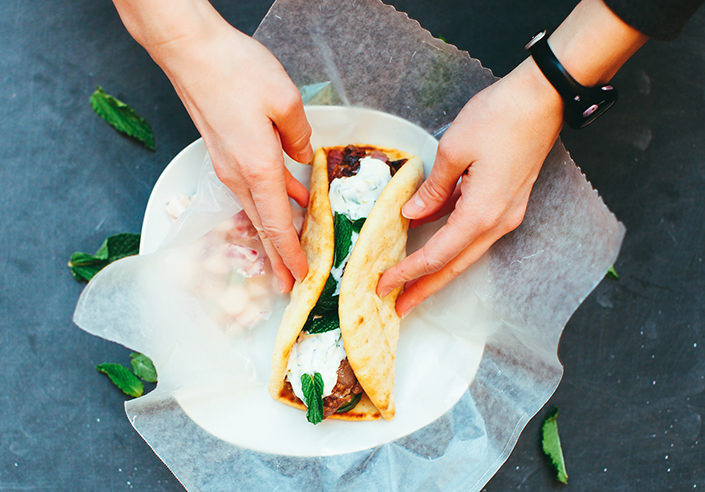
Shawarma is made from marinated meat that has been slow roasted on a vertical spit for many hours – the meat can be anything from lamb, beef or chicken to goat, turkey or a combination of any of these. Once cooked, the meat is carved off in thin, wide strips and stuffed inside a flatbread along with a variety of vegetables, such as lettuce, cucumber, tomatoes, onion, pickles and parsley. Condiments can range from garlic yoghurt to hummus to chilli and pickled mango sauce, and while the type of bread used will vary depending upon where you are, pita, lavash and taboon are most popular.

best shawarma in sydney
CC image courtesy of Karan Jain on flickr http://bit.ly/1OwdMCl

An ancient observation

Most will agree that the secret to shawarma’s taste lies in the way the meat is cooked and much credit must go to the chefs of the Ottoman Empire (1299 – 1923) who were among the first to see the benefit of roasting meat vertically. They noticed that horizontal roasting robbed the meat of all of its delicious fat as it simply dripped into the fire; worse still, as it did so it caused the flames to rise, scorching the outside of the meat as a result. Vertical roasting means that the meat is bathed in its own fat as it cooks, making it soft, tender and delicious, and keeping the flames under control allows the meat to be roasted nice and slowly, cooking it to perfection.

Born in Bursa

While the Ottomans certainly got the ball rolling with their vertical roasting system, it seems that the shawarma we all know and love today didn’t come into being until the late 1800’s thanks to a man by the name of Iskender Efendi. It is believed that Efendi made the first shawarma around 1870 in the Turkish city of Bursa, a creation he called the kebab. Kebabs quickly became popular throughout Turkey and before long this delicious dish had spread to cultural cuisines across the Middle East, the Mediterranean and beyond, adapting and evolving as it went.

shawarma delivery inner west
CC image courtesy of warden.warden on flickr http://bit.ly/1QhonFb

The expat effect

Prior to World War 2 the many versions of shawarma were for the most part a well-kept secret, unknown to the Western world; however, this would soon change. Following the war, many Turkish people relocated to countries all over the world, with a particularly large group moving to Germany; the impact on the local cuisine was profound to say the least. By the early 1970’s Germans had fallen head over heels for the Turkish shawarma, with thousands of kebab shops opening all over the country. This explosion of kebab love would play a vital role in spreading shawarma throughout the Western world.

What is the difference between shawarma and gyros?

You may be thinking that shawarma sounds awfully similar to its Greek counterpart, gyros. If you are you are not wrong. Both both contain slivers of meat wrapped up in pita bread alongside fresh veggies. Traditionally, the meats are cooked in much the same way: vertically, and both have a reputation for being classic street food, revered within their respective cultures for ages. So, what sets shawarma apart?

The answer lies in the garnish. Shawarma is all about the delicious sauces that accompany the meat – typically garlic yoghurt or tahini and hommus – and the secret ingredient: pickles. Pickled vegetables are what take shawarma to a whole new plane: pickled cucumbers, turnips, and even carrots or mangoes are common. Take your pick, they’re all delicious.

what is shawarma

How do you make Shawarma?

Shawarma can be made quite easily at home with a number of ingredient combinations.

Firstly, select your meat of choice. Prepare it the way you like: we suggest marinating thinly sliced beef, chicken or lamb overnight to ensure maximum flavour (shawarma spices include cumin, all spice, sweet paprika, oregano, cinnamon, cardamom and pepper). Then, cook your meat in a frying pan along with the marinate until juices have evaporated and the meat is cooked.

Place your meat fillets on warm, lightly toasted Lebanese flatbread, top with lettuce, tomato, pickles, pickled turnips and red onion. Drizzle generously with sauce. Our condiment of choice is a delicious garlic yoghurt sauce, however, tahini is also is great choice.

Wrap up tightly and serve.

Today you can find shawarma just about everywhere, from Lebanon and England to Egypt and Australia, with every culture boasting their own style and flavour. If you’d like to try the most delicious of them all, drop by OOSHMAN (formerly known as Manoosh) or order from us online, because nothing can compare to our freshly-made shawarma wraps.

Categories
Lebanese Food Traditional Ingredients Blog

The Story of Haloumi

Known to the Turks as hellim, to the Arabs as hallum and to the Italians as calumi, few cheeses can get taste buds tingling and pulses racing quite like haloumi. If you have yet to discover this heavenly cheese, brace yourself for something special, because you will never forget your first taste of haloumi. Let’s take a look at the story of Haloumi and see what all the fuss is about.

the story of haloumi
CC image courtesy of Elin B on flickr http://bit.ly/1RtIyx8

People have been singing haloumi’s praises for hundreds of years, nowadays, haloumi is a core element of cultural cuisines all over the world, from Lebanon to Egypt to Sudan.

What is Haloumi?

Haloumi is a hard, white cheese traditionally made from a mixture of sheep and goat milk, though nowadays cow’s milk is sometimes added too. It looks a lot like mozzarella but it is a whole lot saltier, and because haloumi has a higher than average melting point it is one of the few cheeses that you can grill or fry, making it perfect for everything from Lebanese pizza to traditional Aussie barbeques.

best haloumi inner west sydney

The pride of Cyprus

Haloumi hails from the Mediterranean and was first made on the island of Cyprus during the Medieval Byzantine period (AD 395 – 1191). Cypriot famers relied on haloumi as a source of protein and in many villages the entire community would join forces and make huge batches together. Recipes varied from village to village, with each taking great pride in their special technique and secret ingredients. Haloumi became so important to village life that even the surnames of many Cypriot families reflect their role in haloumi production, with names such as Hallumas, Halluma and Hallumakis common by the 19th century.

haloumi pizza sydney
CC image courtesy of Leonid Mamchenkov on flickr http://bit.ly/1RtJ9Pp

Hearty and mobile

Haloumi was created at a time before refrigeration when it was vital that foods were made to last. Thankfully, because haloumi was stored in salty brine it could keep for long periods without spoiling and early producers found that wrapping haloumi in mint leaves further helped to maintain its freshness and flavour. Haloumi’s impressive staying power made it popular not just with rural families but also with those who travelled long distances, such as the Bedouin tribes who regularly passed through the area.

A taste to write home about

People have been singing haloumi’s praises for hundreds of years, with one of the earliest written mentions coming in AD 867 courtesy of the poet Giorgios Vizinos in his popular poem ‘The Poor Cypriot’. Leonardo Donato (the military leader of Venice from 1606 – 1612) became so enamoured with haloumi during a visit to Cyprus that he recorded intricate details regarding how to make it, while Greek writer Arximandridis Kiprianos raved about haloumi’s distinctive flavour in his book “The Chronological History of Cyprus Island”.

lebanese pizza haloumi
CC image courtesy of Krzysztof Belczyński on flickr http://bit.ly/1MfPgXj

Making magic

There is a definite art to making haloumi that takes years to master; however, the basics are as follows;

  • Add unpasteurised sheep and goat milk to a large pot and heat to approximately 32 degrees Celsius.
  • Add rennet (a stomach enzyme found in young animals); this will cause the milk to separate into curds and whey.
  • Remove the curds as they separate, press them into small rectangular moulds and leave them to cool.
  • Take the cooled, pressed blocks from their moulds and simmer them in the whey until they float (approximately 45 minutes).
  • Remove the blocks from the whey and allow them to cool. You now have haloumi!
  • Soak the haloumi in salty brine for at least 24 hours before consuming.
  • Enjoy your fresh haloumi however you like, though grilled or fried are the most popular options.

Nowadays, haloumi is a core element of cultural cuisines all over the world, from Lebanon to Egypt to Sudan. To get a taste of this ancient delicacy, drop by OOSHMAN (formerly known as Manoosh) or order from us online, because no one makes haloumi quite like we do.

Categories
Traditional Ingredients Blog Lebanese Food

The Mighty Mezze

There is no greater symbol of Lebanese culture than the mighty mezze, as not only does it involve eating lots of healthy and delicious food (usually in the form of a smorgasbord-like spread), but it is all about enjoying quality time with family, friends and loved ones. While the word itself is derived from the Persian term “maze” – meaning ‘to snack’ – don’t let the name fool you, because an authentic mezze is certainly no appetizer. While there are no strict rules regarding what a mezze should comprise, to be considered an authentic Lebanese version the following elements are a must.

best mezze inner west
CC Image courtesy of Wikipedia http://bit.ly/1MoAQWe

No one knows how to enjoy a quality meal quite like the Lebanese as every dish is viewed as a reason to celebrate.

Bread

You simply can’t have a traditional mezze without fresh baked bread as it provides the perfect vessel with which to enjoy all of those delicious dips and tasty morsels. While pita is the most popular bread commonly included on a mezze table you may also find a plate or two of paper-thin bread known as marqouq.

Manoosh lebanese bread sydney
CC image courtesy of jeffreyw on flickr http://bit.ly/1Dtyqwz

Haloumi

If you like cheese you will absolutely love haloumi and any self-respecting mezze will always feature a plate or two of this heavenly hard white cheese. Although not strictly Lebanese in origin, Haloumi has now become a Lebanese staple. Made from a combination of sheep and goat’s milk, haloumi is perfect for grilling and its wonderfully salty flavour will keep you coming back for more.

Tabbouleh

This classic Lebanese dish has been part of our cultural cuisine for thousands of years and is an essential element of any mezze. Featuring bulgur wheat, tomatoes, parsley, mint, cucumber, olive oil and lemon juice, tabbouleh is healthy, delicious and provides a touch of freshness perfect for those hot summer days.

the secret of terrific tabbouleh

Falafel

No mezze table can be considered authentic without falafel. Apart from providing a great source of protein, vitamins, minerals and a taste that is impossible to match, falafel balls provide the perfect way to enjoy all those delicious dips, making them so easy to devour and enjoy.

best mezze inner west

Hommus

A traditional mezze needs to have plenty of tasty dips and none are more important than hommus. This classic mezze mainstay is made from a blend of chick peas, tahini, lemon juice, garlic and a healthy drizzle of olive oil, and it is as full of flavour as it is good for you.

Baba Ghanouj

This mouth-watering eggplant delicacy is always one of the most popular elements of any authentic Lebanese mezze. Baba ghanouj has a unique flavour and personality that goes perfectly with fresh bread, falafel or even a slice of grilled haloumi.

Olives

Lebanese people are rather fond of their olives and so you can expect to see both the green and black varieties on any mezze table. When enjoying mezze in Lebanon it is common to be treated to a selection of fresh olives that have been grown by your host, or at least by a friend, neighbour or cousin.

lebanese mezze

No one knows how to enjoy a quality meal quite like the Lebanese as every dish is viewed as a reason to celebrate. If you’d like to enjoy an authentic mezze with your friends or family drop by OOSHMAN (formerly known as Manoosh) or order from us online. We have the best mezze in the inner-west and are experts in the art of modern and traditional Lebanese food

Categories
Blog Lebanese Food Traditional Ingredients

The Secrets of Terrific Tabbouleh

Few dishes are more closely associated with Lebanese culture than tabbouleh and you won’t find a fresher, healthier or tastier food anywhere in the world. Here we will take a brief look at the history of this amazing food as well as some of the secrets behind its popularity.

the secret of terrific tabbouleh

Few foods have won over the hearts of their fans quite like tabbouleh, particularly in Lebanon where there is even a national day celebrated in its honour.

What is Tabbouleh?

Refreshing, healthy and delicious, tabbouleh is often referred to as a salad though many Lebanese view it as a dish in its own right. Regardless of how you define it, tabbouleh is one of Lebanon’s most popular foods and is perfectly suited for those long, hot Mediterranean summers.

The Origin of Tabbouleh

The name tabbouleh comes from the Arabic word ‘taabil’ which means to season or spice and tabbouleh is thought to have first been eaten in the mountains of Lebanon and Syria more than 4000 years ago. Ancient scholars believe that herbs known as ‘qadb’ formed a crucial part of the Arab diet throughout the Middle Ages and were used as the basis of many popular dishes, including tabbouleh.

Variations of tabbouleh can be found throughout the Middle East and beyond, from the Armenian ‘eetch’ to the Turkish ‘kisir’ right through to the Cypriot ‘tambouli’. Lebanese immigrants even introduced a version of tabbouleh to the Dominican Republic known as ‘tipile’.

best tabbouleh sydney
CC image courtesy of rabiem22 on flickr http://bit.ly/1HekffD

The Secret Ingredients…

As with most Middle Eastern food, the secret to authentic tabbouleh is based on fresh local ingredients and while there are many different versions, the following should be considered essential elements.

Bulgur – One of tabbouleh’s most recognizable ingredients, bulgur is made from wheat berries that have been partially ground, cooked and dried. The best wheat for making bulgur is grown in the mountains of Lebanon, Syria and nearby Jordan and is known as salamouni.

Parsley – Tabbouleh’s greens are provided mostly in the form of fresh parsley; however, mint, green onions and even cucumber are sometimes added as well.

Tomatoes – No tabbouleh is complete without a healthy dose of finely chopped tomatoes and the fresher they are the better.

SeasoningsQuality olive oil is an absolute must as is a serious splash of freshly squeezed lemon juice. If you are looking for a little extra kick add a clove of garlic or two.

the origin of tabbouleh
CC image courtesy of cyclonebill on flickr http://bit.ly/1LmImxC

Health Benefits

Tabbouleh isn’t just delicious; it is extremely good for you as well! Apart from the vitamins and minerals provided by the fresh greens, tomatoes and lemon juice, bulgur is a fantastic source of protein, fibre and essential minerals. Olive oil comes with countless benefits as well, from helping to lower blood pressure right through to reducing the risk of Type 2 diabetes.

A Salad Worth Celebrating

Few foods have won over the hearts of their fans quite like tabbouleh, particularly in Lebanon where there is even a national day celebrated in its honour. The first Saturday of July each year is known as National Tabbouleh Day, with people getting together to enjoy this beloved dish in homes, parks and restaurants all over the country.

Life simply isn’t complete without a bowl of tabbouleh every now and again. If you’d like to try authentic Lebanese tabbouleh made the way it was meant to be, drop by OOSHMAN (formerly known as Manoosh) or order online, because when it comes to fresh and healthy Lebanese food we simply can’t be beat.

Categories
Blog Lebanese Food Traditional Ingredients

The Secret of Superb Sambousek

Whether you are a fan of falafel, a lover of lahembajin or a connoisseur of kebbeh, no Lebanese food experience is truly complete without a sambousek or two. Here we will take a closer look at one of the Middle East’s most beloved snacks – prepare to meet your new favourite food.

best Sambousek sydney
CC image courtesy of Wikimedia Commons

Many countries, cultures and families have their own secret recipe and special technique for making Sambousek

What is Sambousek?

Also known as sambousik, sambousak or samboosak, sambousek is essentially a small pastry filled with either meat or cheese. In Lebanon, lamb is the meat of choice and cheeses can range from haloumi to nabulsi right through to feta. Onions, herbs and spices provide the flavour while pine nuts add a deliciously nutty texture and taste. These popular pastries can be either baked or fried and are often served as part of a classic Lebanese mezze spread.

A taste of Persia

As with many of the Middle East’s most popular foods, there is much contention surrounding who created the sambousek; however, it seems almost certain that it was first eaten around the 10th Century in Persia. Early records refer to a poem recited in honour of sambousek at a 10th Century banquet in Baghdad, while Persian historian Abu’l -Fazl Bayhaqi makes mention of sambousek around the 11th Century in Tarikh-e Beyhaghi, his written history of the Persian Empire.

best sambousek inner west
CC image courtesy of dynamosquito on flickr – http://bit.ly/1MxAbAJ

An influential snack

Ancient scholars believe that traders from Central Asia introduced sambousek to India sometime around the 13th or 14th century and not only did this tasty pastry quickly become popular, but after incorporating the local flavour and culture it would evolve into the much loved Indian samosa. Another version of sambousek created by Sephardi Jews spread throughout North Africa, Portugal and Spain, providing the inspiration for what would become one of Spain’s most popular foods, the mouth-watering empanada. Today you can find versions of the sambousek right across Central Asia, the Middle East and beyond.

best sambousek newtown lebanese food
CC image courtesy of Harold Litwiler on Flickr – http://bit.ly/1MpD3v9

A Ramadan essential

This beloved pastry holds a special place in the hearts of Islamic people everywhere as it has long been considered an essential element of our iftar meal – this is the meal eaten to break the fast at the end of each day during Ramadan. Sambousek provides the ideal way to get the energy and nutrients your body needs without overburdening an empty stomach and you won’t find many foods that can compare with the sambousek for taste.

How to make sambousek

Every country, culture and family has their own secret recipe and special technique for making sambousik; however, the basics are as follows.

  • Prepare a simply pastry dough and roll it out flat.
  • Sauté onions and ground lamb in a large frying pan with oil, then add pine nuts and your favourite spices (baharat and za’atar are popular choices). Once the meat is browned, remove the mixture from the heat and allow it to cool.
  • Cut your dough into small discs (roughly the size of a measuring cup) and fill each one with your meat mixture. Fold them into crescent shapes and seal with your fingers.
  • Heat oil in a large frypan to roughly 180C.
  • Fry your crescent pastries until golden brown then place them on paper towels so that any excess oil can drain.
  • Your sambouseks are now ready to enjoy! Serve hot or cold with your favourite dip.

Whether you have been enjoying sambousek for years or are looking to try one for the very first time, nobody makes them quite like we do. Drop by OOSHMAN (formerly known as Manoosh) or order online, we are proud to have the best sambousek in Sydney and would be honoured to prepare a fresh batch for you.

Categories
Blog Lebanese Food Traditional Ingredients

A Look at Modern Lebanese Cuisine

There is no more popular food in the world right now than Lebanese cuisine, so whether you are fiending for a falafel in Florida or have a hankering for some hommus in Helsinki, chances are good that you have a few delicious options nearby. This article takes a brief look at modern Lebanese cuisine and what the fuss is all about.

modern lebanese cuisine
CC image courtesy of Vera Yu and David Li on flickr http://bit.ly/1VMmIaH

If you are one of the few who has yet to discover modern Lebanese food prepare yourself for a life-changing experience, and no one puts a modern spin on an ancient delicacy quite like we do.

Fresh and healthy

Middle Eastern food has always been based on using fresh, local ingredients, so now that a lot more people are trying to eat healthier it is no surprise to see the popularity of our food skyrocket. Whether you are looking for a tasty snack, a nutritious lunch or a sit down meal that will delight the entire family, you won’t find a fresher, healthier and more delicious option than Lebanese cuisine.

lebanese pizza sydney
CC image courtesy of Charles Haynes on FLickr http://bit.ly/1Jwq8ur

Traditional yet modern

In many ways Lebanese food is the same today as it was hundreds of years ago, embracing the same techniques, tastes and traditions. Spices such as za’atar date back to the time of the Pharaohs while our use of ingredients such as olive oil and chick peas are as ancient as the land itself. However, with Lebanese people now living all over the world many have begun incorporating local flavours and ingredients into their secret family recipes. This has seen traditional dishes embracing local influences like never before, putting a modern twist on ancient classics with delicious results, such as lobster hommus and kale fattoush.

best lebanese takeaway sydney

Award winning taste

Lebanese food has enjoyed an almost underground following for many years; however, with our restaurants now starting to win industry awards it seems that the cat is finally out of the bag. From New York City restaurant Ilili taking home the coveted Five Star Diamond Award this year to our very own OOSHMAN dominating Menulog’s Best Takeaway Restaurant category recently, it seems that Lebanese food finally has the attention of discerning modern diners.

Redefining pizza

It is fair to say that Lebanese food has now become part of mainstream cuisine worldwide, from food trucks in Toronto right through to fine dining in Paris, though one of its greatest areas of influence has been in the world of pizza. While pizza is certainly nothing new to Lebanese people – after all, we have eaten manoosh (a type of flatbread with za’atar and olive oil) for thousands of years – our ancient spices and flavours have proved to be the perfect complement for the modern pizza. No longer is it uncommon to see pepperoni pizza being sold alongside lahembajin and pizza lovers are discovering that combinations such as mozzarella and haloumi are indeed a match made in heaven.

best lebanese pizza sydney

If you are one of the few who has yet to discover modern or traditional Lebanese food prepare yourself for a life-changing experience, and no one puts a modern spin on an ancient delicacy quite like we do. Stop by OOSHMAN (formerly known as Manoosh) or order online and treat yourself to the best modern Lebanese cuisine in Sydney. We guarantee you will be glad that you did.

Categories
Blog Lebanese Food Traditional Ingredients

What is Baba Ghanouj?

Also known as baba ghanoosh, baba ghanouj is a type of smoked eggplant dip that has been part of Lebanese cuisine for thousands of years. It is believed to have first been eaten in the Levant (a region comprising modern day Lebanon, Syria, Jordan, Palestine and Israel) though nowadays everyone from Egypt to Turkey has their own version. As is the case with any popular food, there is much debate surrounding what constitutes the real thing; here is a brief look at what goes into making traditional Lebanese baba ghanouj.

what is Baba ganoush
CC Image courtesy of avlxyz on Flickr http://bit.ly/1Pq5KeA

Lebanese foods don’t get much healthier, more delicious or authentic than baba ghanouj. Time to get a taste of what the fuss is all about.

Aubergine (Eggplant)

If you like eggplant you will love baba ghanouj as it is all about the aubergine. The secret is to roast the eggplants directly over an open flame as this leaves behind a delicious smoky flavour that is the trademark of this traditional Lebanese food. Once cooked, the eggplant is peeled and strained – as this prevents the flavours from being watered down – and finally, that soft aubergine is gently mashed until it is as smooth or chunky as you like.

best baba ghanouj sydney
CC image courtesy of Håvar og Solveig on Flickr – http://bit.ly/1O0Ii8K

Garlic

You can’t have baba ghanouj without garlic, although opinions vary regarding the quantities required. Recipes differ from family to family, with some adding one clove of garlic for every eggplant while others add just the one clove to the entire batch. Whatever your taste, for your baba ghanouj to be considered authentic it needs a noticeable kick of garlic.

Lemon Juice

Baba ghanouj requires a definite touch of citrus, which is traditionally provided by way of lemon juice – again, opinions vary regarding the level of citrusy zing necessary. Ideally, you want the citrus flavours to compliment the smokiness of the eggplant but without overpowering it.

Tahini

Many styles of baba ghanouj don’t contain tahini, but the traditional Lebanese version certainly does; however, keep in mind that the role of the tahini is to compliment the other flavours, not steal the show. Only by balancing the nutty flavour of the tahini with the smokiness of the eggplant, the zap of the garlic and the zing of the lemon can you create that real baba ghanouj magic!

Seasoning

Every Lebanese family has their own way of seasoning their baba ghanouj, though thanks to all that garlic, lemon and tahini only the slightest extra touch of flavour is needed. Salt, cumin and even chili powder are often used and some people mix fresh herbs directly into their baba ghanouj to provide a burst of flavour. Mint and parsley are by far the most popular garnishes.

Olive Oil

Like almost every Lebanese dish, baba ghanouj isn’t complete without a drizzle of olive oil on top. A popular approach is to pour a moat of olive oil around the edge of the dish prior to serving, as this ensures that there is a taste of that delicious oil in every bite.

best baba ghanouj inner west
CC image courtesy of USDA on Flickr http://bit.ly/1JEBzOQ

Lebanese foods don’t get much healthier, more delicious or authentic than baba ghanouj. To get a taste of what all the fuss is about, drop by OOSHMAN (formerly known as Manoosh) or order online – you haven’t lived until you’ve tried our baba ghanouj!

Categories
Blog Lebanese Food

New Specials Board | Best in the West

We like to keep things fresh, and have a new specials board featuring Vegan Pizza, Lamb Souvlaki Wrap, and Spinach and Cheese Wrap. Try some of the best pizza in Sydney. Some of these are for a limited time only, so Drop by OOSHMAN (formerly known as Manoosh) or order online today.

Special Menu Items

1. Vegan wonder – Vegan cheese, mushroom, garlic, vegan pepperoni, marinated broccolini served with a lemon wedge on a medium size pizza. $9

2. Lamb Souvlaki wrap – Marinated lamb souvlaki, lettuce, tomato, spanish onion and cucumber drizzled with tzatziki sauce in a fresh baked wrap. $7

3. Spinach and cheese wrap – cheese, spinach and fetta wrapped in our delicious baked sesame wrap. $5.50

best vegan pizza inner west

Categories
Blog Lebanese Food

Vegan Pepperoni is Here! | Vegan Pizza Inner West

We’re very pleased to announce we are now serving delicious Vegan Pepperoni as part of our range of Vegan Pizzas. Good news for those needing a vegan pizza in the inner west or those who just want to try something a little different. Our Baklavas are now vegan too and you can try them as part of the combo meal deal. Drop by OOSHMAN (formerly known as Manoosh) or order online.